Buying a house in Amsterdam: from viewing to keys
A practical step-by-step explanation of buying a house in Amsterdam, from financial preparation and viewings to the purchase contract and transfer.

TL;DR
When buying a house in Amsterdam, the sequence usually moves from budget to viewing, offer, purchase contract, financing and transfer. Keep an open list of documents you still need to receive or check.
Five questions to return to:
- Does the home fit your budget after one-off and monthly costs are included?
- Which property, owners’ association and leasehold information is available?
- Which conditions do you want in the offer and purchase contract?
- Which dates apply to signing, the deposit and transfer?
- Who can confirm an answer when a document or clause is unclear?
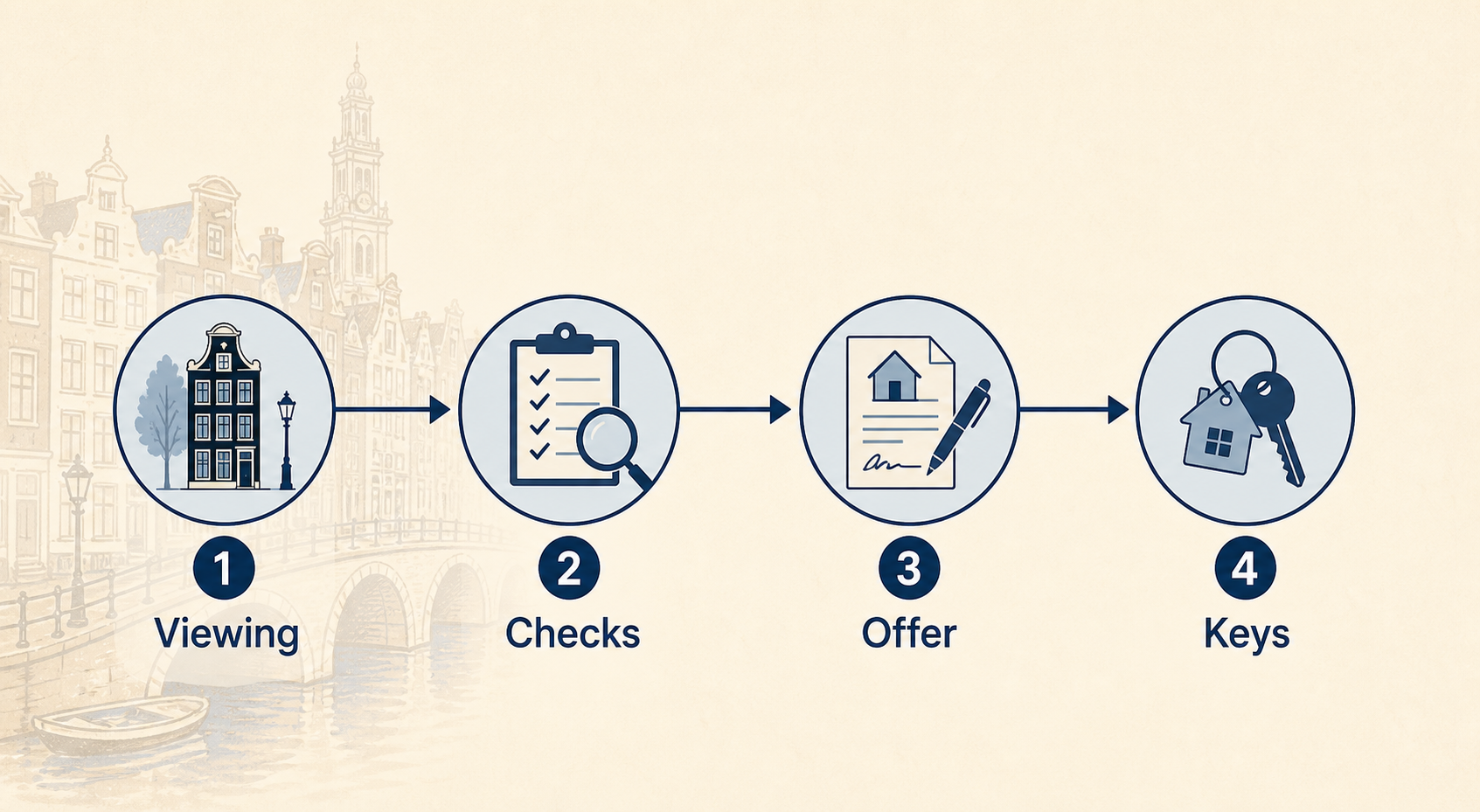
The buying process in one view
A viewing starts your assessment. A short period may follow in which you collect information, make an offer and negotiate. Once the seller accepts, the purchase contract records the agreement. The notary handles the legal transfer later.
Timing varies by home and contract. A seller may set a bidding deadline while the lender needs more time for the mortgage. Treat the sequence as a working sheet that you connect to the actual deadlines.
A buyer can compare the local checks with the Dutch buying process for an Amsterdam home before assigning deadlines to the contract, mortgage and transfer.
1. Prepare your financial room
Before the first viewing, work with an amount you can explain. Ask a mortgage adviser which documents are needed and what monthly payment fits your income, savings and other obligations. Keep funds aside for costs that the mortgage will not cover.
Write down three limits:
- your maximum purchase price;
- the amount that remains for one-off costs and furnishing;
- the monthly payment that leaves room for maintenance, owners’ association charges and surprises.
Include the cost of buying a house in Amsterdam alongside those budget items.
Good buyer preparation keeps your documents and open questions together.
Rijksoverheid’s cost categories for buying a home give you the items to compare before setting an offer, from transfer tax to mortgage and deed costs.
An online calculation is an initial indication. The lender assesses your income, employment terms, debts, assets and the home itself. Ask early which assumptions sit inside the calculation.
2. Use the viewing as a checkpoint
Look beyond layout and light. Ask for information about maintenance, alterations, the energy label, the owners’ association and leasehold. With an apartment, find out how the association operates, what reserve fund exists and which works have been discussed.
For leasehold, check the ground rent, period, conditions for buyout or transition and possible arrears. Before you price the home, the ground-rent, period and buyout details need to be clear, including any arrears.
For each home, write down what you saw, what you heard verbally and which document should confirm the answer. That separation keeps a first impression from becoming a fact in your notes.
3. Set your offer and conditions
An offer includes more than price. Consider the preferred transfer date, movable items, a financing condition, a building inspection, the sale of another home and other conditions that let you withdraw. The right wording depends on the negotiation, so discuss it with your estate agent or legal adviser.
Before making the offer, run three figures: the purchase price, one-off buying costs and the monthly payment after financing. That keeps price connected to the rest of the decision.
Ask which documents the seller can provide and by when. A lower price can sit alongside deferred maintenance, leasehold conditions or a short transfer date. Use that signal to check more carefully before deciding.
4. Read the purchase contract before signing
In the Netherlands, a home purchase contract binds buyer and seller once both have signed it, with a statutory cooling-off period for a private buyer. The purchase-contract rules explain why the phrase “provisional purchase contract” does not make a signed agreement optional.
The statutory cooling-off period lasts three days. Notaris.nl says two of those days must be working days. The period starts on the day after the buyer receives a signed copy. Check the exact dates in your file and ask the notary when you need confirmation.
Before signing, read at least:
- the purchase price and what belongs to the home;
- the conditions and deadlines;
- the deposit or bank guarantee;
- the handover condition and agreed work;
- the transfer date and penalty clauses;
- the leasehold, owners’ association and known-defect information.
5. Arrange financing, deposit and notary work
After signing, the mortgage process continues. Send documents promptly, and ask before taking on a new obligation that could affect the mortgage. Check the deadline for the financing condition and the date on which the bank guarantee or deposit must be arranged.
Put the next dates on an Amsterdam home-buying timeline so the financing condition, deposit and notary appointment have named owners.
A purchase contract may ask for a deposit or bank guarantee of often 10% of the purchase price. Your contract sets the amount, deadline and consequences. The notary receives the documents and manages the legal transfer. The contract-signing and transfer steps put the deposit, bank guarantee and notary appointment in the right order.
Ask the notary for a draft deed of transfer and a statement of amounts. Check names, address, purchase price, leasehold details and unusual provisions. A mistake is easier to correct before the appointment.
6. Prepare for transfer
During the final phase, arrange a handover check with the seller or estate agent. Compare the home with the contract, record meter readings, count keys and check agreed items. Report differences to the people involved straight away.
Make sure your identity document is valid and your own funds are available on time. Arrange insurance, energy and other accounts around the moving date. Keep signed papers, deeds, plans, owners’ association information and warranties in one folder.
At the notary appointment, you sign the deed of transfer and, when borrowing, the mortgage deed. After payment and registration, the keys can be handed over according to the agreement. The notary explains which step happens when.
Common problems and a useful response
A document is missing
Ask which document is missing, who can provide it and which decision depends on it. Add the question to your file and hold the decision until the answer has been checked.
The mortgage is delayed
Ask the lender which documents remain and place the contract date beside the financing-condition deadline. Contact the estate agent and notary as soon as a deadline looks at risk.
Leasehold terms are unclear
Ask for the ground rent, period, buyout, transition and arrears to be confirmed in writing. Amsterdam points buyers to the leasehold contract and municipal records. A change can affect the budget and mortgage.
The home is handed over differently
Record the difference with photos and ask the seller what remedy is available. Have the agreement confirmed in writing before the final payment or transfer is completed.
Buyer checklist for the final week
One week before the appointment
- read the draft deed and statement of amounts;
- check the appointment, location and attendees;
- confirm insurance, energy and moving arrangements;
- ask which funds and identity documents the notary expects;
- schedule the handover check.
The day before
- confirm that your own funds are available;
- put identification, the contract and questions together;
- confirm how the keys will be handed over;
- note the meter readings you want to record.
On transfer day
- check the home and agreed items;
- ask about any document you do not understand;
- sign once the explanation is clear to you;
- store deeds and agreements in a fixed place afterwards.
What happens after the keys?
Photograph the starting meter readings and test locks, smoke alarms and installations. Update your address with the organisations you need and keep the owners’ association, insurer and maintenance contacts together.
Read the association budget and house rules again after moving in. Record maintenance mentioned earlier and keep money aside for the work. For leasehold, keep the contract and ground-rent or buyout information with the other home documents.
Costs belong in every stage
The purchase price sits at the centre, but your budget also includes one-off buyer costs, financing, the notary, taxes, owners’ association charges and the cost of living in the home after transfer. Keep these amounts beside your offer and mortgage figures.
Possible purchase costs include transfer tax, the mortgage deed and the transfer deed, along with valuation, inspection, mortgage advice and estate-agent fees. Which ones apply depends on the home, financing and agreements you make.
Questions buyers often ask
When does the cooling-off period start?
For a private purchase, it starts on the day after the buyer receives the contract signed by both parties. It lasts three days, including two working days. Ask the notary to confirm the exact end date for your file.
Is a provisional purchase contract optional?
The phrase can mislead. A signed home purchase contract binds buyer and seller, subject to the statutory cooling-off period and the conditions written into the contract. Read the agreement before signing.
How much is the deposit?
Many contracts ask for a deposit or bank guarantee of 10% of the purchase price. The contract sets the amount, deadline and consequences of failing to complete.
Should I arrange a building inspection?
An inspection can reveal defects and maintenance needs. The right timing and effect on the offer or conditions depend on the home and negotiation. Discuss it before making the offer.
What should I check with leasehold?
Check the ground rent, period, contract conditions, buyout or transition and possible arrears. Request the records and place the financial effect beside your mortgage room.
Who can explain my purchase contract?
A notary can explain the legal deed and transfer. A mortgage adviser handles financing; an estate agent can help with property and negotiation questions. Ask each professional where their role ends.
Next step
After each viewing, keep one short list: what do you know, what do you still need and who can confirm it? Put those questions beside your budget so the next call has a clear purpose.
Use this sequence to ask questions in time. Have the purchase contract, financing and leasehold terms confirmed for your home before signing.
Review the costs →